GST for E-commerce Sellers in India (Complete Guide 2026)
Understand GST rules for Amazon, Flipkart, and online sellers. Learn registration, compliance, and tax requirements.
E-commerce Experts
100% Compliance
Fast Registration
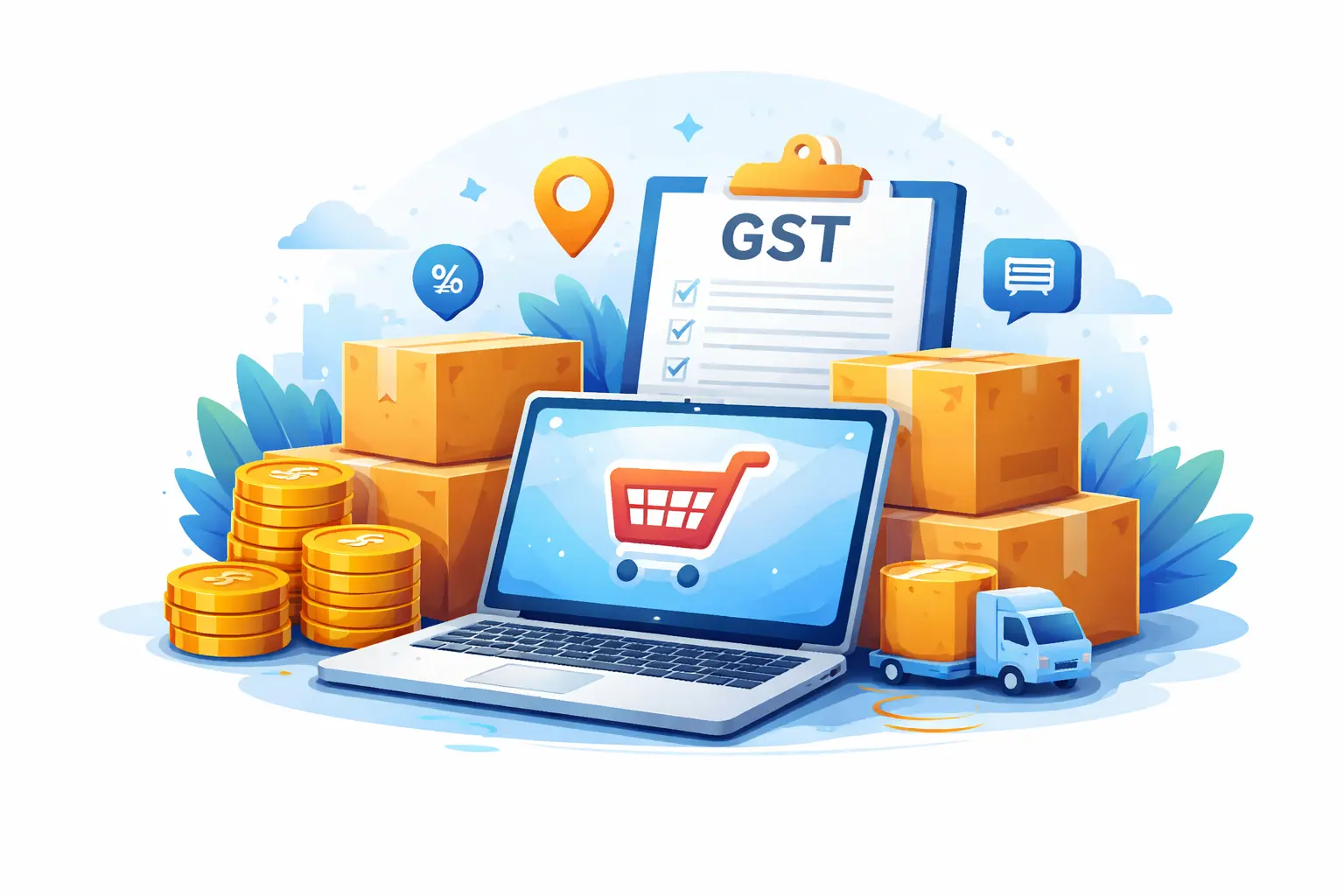
Is GST Mandatory for for E-commerce Sellers?
GST for e-commerce sellers refers to the mandatory tax registration and compliance required for businesses selling goods or services through online platforms like Amazon, Flipkart, Meesho, and others. Under GST law, sellers operating through e-commerce platforms must register under GST regardless of turnover limits and comply with return filing requirements.
Why GST is Mandatory for Online Sellers
E-commerce platforms require GSTIN for seller onboarding
TCS is deducted on every sale made through the platform
Interstate supply rules apply to most online transactions
GST law specifically mandates registration for online sellers
Platform Onboaring
E-commerce platforms require GSTIN for seller onboarding
TCS Deduction
TCS is deducted on every sale made through the platform
Exporting Services
Exporting services outside India
E-commerce Sellers
Selling through online platforms
Voluntary Registration
Even if below turnover threshold, you can register voluntarily to claim input tax credit
GST Mandatory for
What is TCS in GST for E-commerce?
E-commerce platforms collect TCS (Tax Collected at Source) at 1% on sales made through their platform.
This amount is deposited with the government and reflected in the seller’s GST account.
Under GST law, any person supplying goods through an e-commerce operator is required to obtain GST registration compulsorily. This rule overrides the basic exemption limit, meaning sellers cannot claim the ₹20 lakh or ₹40 lakh threshold if they are selling online.
E-commerce platforms such as Amazon, Flipkart, and Meesho are required to collect Tax Collected at Source (TCS) on behalf of sellers. To receive this TCS credit and continue selling on these platforms, having a valid GSTIN is mandatory.
TCS Rate Under GST
For interstate transactions, IGST @ 1% is applicable.
How TCS Works
- Customer places order on Amazon/Flipkart
- Customer places order on Amazon/Flipkart
- Platform deducts 1% TCS
- Platform deducts 1% TCS
- TCS is deposited with GST government
Example
A seller sells products worth ₹1,00,000 on Amazon.
- TCS deducted = ₹1,000 (1%)
- Seller receives = ₹99,000
- ₹1,000 is deposited with GST and shown in seller’s account
Seller can later claim this ₹1,000 while filing GST returns
GST Compliance for E-commerce Sellers
GST compliance for e-commerce sellers refers to fulfilling all tax-related obligations such as registration, return filing, tax payment, and reconciliation while selling through platforms like Amazon, Flipkart, and Meesho.
Failure to comply can lead to penalties, account suspension, and legal notices.
Key GST Compliance Requirements
GST Registration (Mandatory)
All e-commerce sellers must obtain GST registration, regardless of turnover. Without GSTIN, you cannot sell on platforms like Amazon or Flipkart.
GSTR-1 Filing (Sales Return)
GSTR-1 is used to report all outward supplies (sales). It must include invoice-wise details of products sold through e-commerce platforms.
GSTR-3B Filing (Monthly Summary)
GSTR-3B is a summary return where sellers declare total sales and pay GST liability. It must be filed every month, even if there are no sales.
TCS Reconciliation
E-commerce platforms deduct TCS (1%) and report it to GST.
Sellers must reconcile:
* Platform sales data
*GST returns
*TCS reflected in GST portal
Mismatch can lead to notices
Tax Payment
Sellers must pay GST on their net tax liability after adjusting input tax credit and TCS. Timely payment avoids interest and penalties.
Invoice & Record Maintenance
Proper invoices must be generated for every sale with GST details. Records must be maintained for audit and compliance purposes.
Registering your business under GST provides several advantages that help businesses operate legally, claim tax benefits, and expand across India.
Benefits of GST Registration
E-commerce Sellers

Legal Recognition
Obtain a GST Identification number (GSTIN) and operates legally as a recognised Freelancer
Expand Freelancing Opportunities
Registered businesses can work with large companies, corporates, and marketplaces that require GST-compliant vendors. This opens doors to higher-value clients and long-term contracts.

Claim Input Tax Credit
Obtain a GST Identification number (GSTIN) and operates legally as a recognised business

Build Professional Credibility
Having GST registration increases trust among clients and establishes your business as legally compliant. It gives a more professional image compared to unregistered competitors.
Documents Required E-commerce Sellers
GST Registration
Documents Required for GST Registration for Sellers
Why Choose Taxced for
GST Registration
Expert GST Professionals
Our experienced GST experts handle all return filings with accuracy and compliance.
On-Time Filing
We ensure GSTR-3B are filed before deadlines to avoid penalties.
Transparent Pricing
No hidden charges. Our GSTR-3B filing services are affordable and transparent.
End-to-End Support
From document verification to return filing, we handle the complete process.
Frequently Asked Questions
Get answers to common questions about GSTR-3B filing, due dates, penalties, and compliance in India.
Is GST mandatory for e-commerce sellers in India? Y
Yes, GST registration is mandatory for e-commerce sellers, even if turnover is below ₹20 lakh. This applies to platforms like Amazon, Flipkart, and Meesho.
Do Amazon sellers need GST registration?
Yes, Amazon requires all sellers to have a valid GSTIN before listing products. Without GST registration, you cannot sell on the platform.
Is GST required for Flipkart sellers?
Yes, Flipkart sellers must register under GST regardless of turnover, as per GST rules for e-commerce operators.
What is TCS in GST for e-commerce sellers?
TCS (Tax Collected at Source) is 1% tax collected by e-commerce platforms on sales made by sellers and deposited with the government.
Can I sell online without GST registration?
No, GST registration is mandatory for selling through e-commerce platforms, even if your turnover is very low.
What GST returns are required for e-commerce sellers?
E-commerce sellers must file:
- GSTR-1 (sales details)
- GSTR-3B (monthly summary return)
Timely filing is required to avoid penalties.
What is the GST rate for e-commerce sellers?
GST rates depend on the product category being sold. Different goods have different GST rates such as 5%, 12%, 18%, or 28%.
How does TCS affect e-commerce sellers?
TCS is deducted by the platform and reflected in your GST account. Sellers can claim this amount while filing GST returns.
What happens if I don’t comply with GST rules as a seller?
Non-compliance can lead to penalties, interest charges, GST notices, and even suspension of your seller account on platforms.
Can small sellers on Meesho or Amazon avoid GST?
No, even small sellers must register under GST if they sell through e-commerce platforms, regardless of turnover.
Start Selling Online with
GST Compliance
Our experts help e-commerce sellers with GST registration and return filing.