Trusted by Founder & Growing Businesses Across India
One Person Company
Registration in India
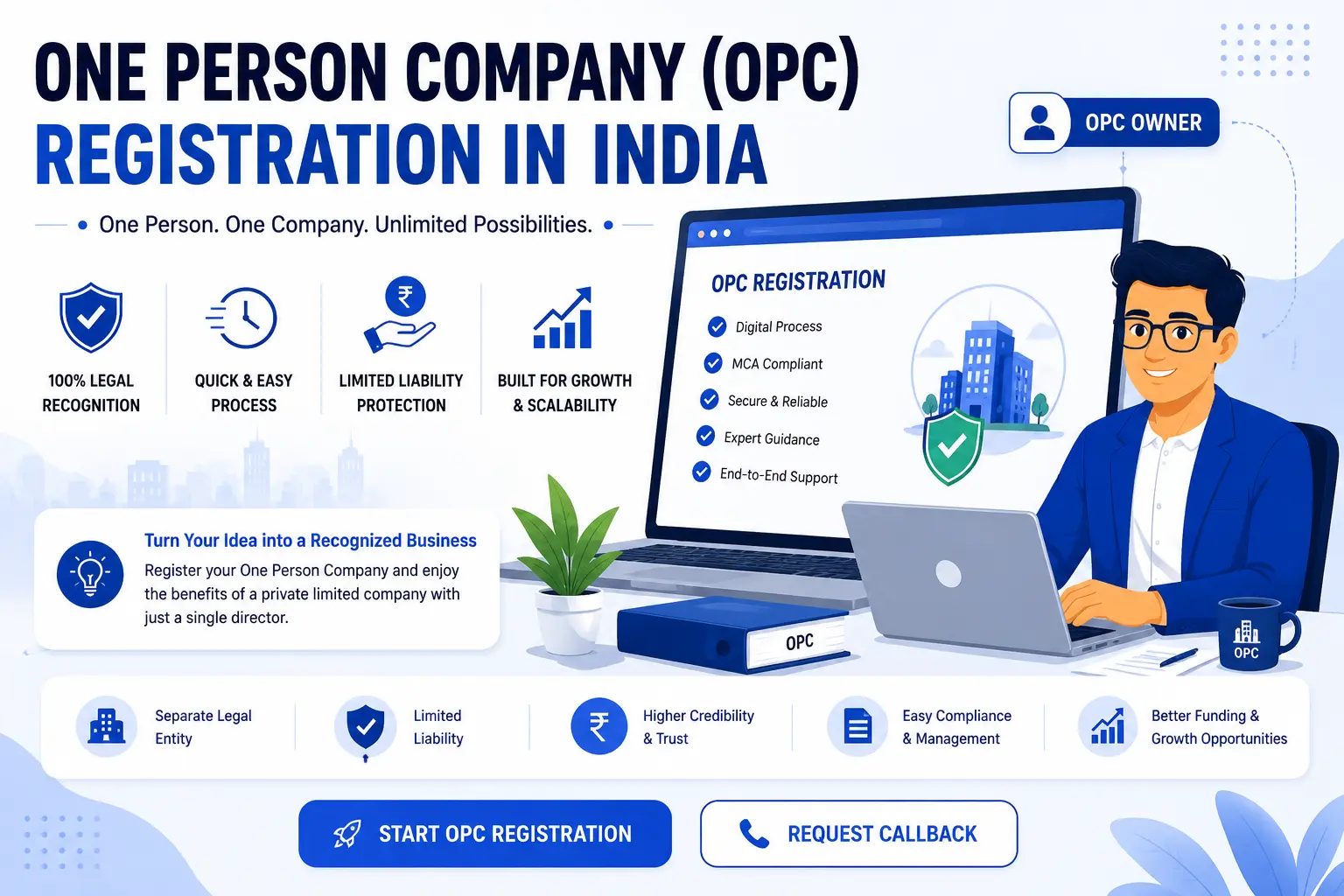
Start your business with a legally recognized corporate structure designed for solo entrepreneurs. Taxced helps founders register their One Person Company (OPC) quickly with expert guidance, compliance support, and startup-friendly assistance.
1000+ OPC Registered
2-5 day turnaround
Verified CAs & CS
Trusted by Founder & Growing Businesses Across India
Start your business with a legally recognized corporate structure designed for solo entrepreneurs. Taxced helps founders register their One Person Company (OPC) quickly with expert guidance, compliance support, and startup-friendly assistance.
✔ Expert consultants
✔ Transparent pricing
One Person Company
Registration in India
What is a
One Person Company (OPC)
A One Person Company (OPC) is a business structure introduced under the Companies Act, 2013 that allows a single entrepreneur to operate a company with limited liability protection and separate legal identity.
Unlike Sole Proprietorship businesses, an OPC is treated as a separate legal entity from its owner. This means the company and the owner are legally distinct, providing better business credibility and protecting the owner’s personal assets from business liabilities.
One Person Company registration is especially popular among:
- Startup founders
- Freelancers
- Consultants
- Ecommerce sellers
- Digital agencies
- Independent professionals
- Small business owners
- Solo entrepreneurs
An OPC structure combines the operational flexibility of a sole-owned business with the credibility and legal advantages of a private limited company.
For entrepreneurs planning long-term growth, brand building, or structured business operations, OPC registration can be a strong business foundation.
One Person Company (OPC)Registration Allows Businesses To:
Operate as a Separate Legal Entity with better business credibility and legal recognition.
Enjoy Limited Liability Protection by separating personal and business liabilities.
Build Higher Trust among clients, vendors, banks, and investors.
Access Better Funding Opportunities including loans, investments, and government schemes.
Scale Professionally while maintaining simple ownership and management structure.
Benefits of
One Person Company
in india
Start your business with minimal compliance, complete control, and affordable setup costs — ideal for freelancers, consultants, local businesses, and first-time entrepreneurs.
Separate Legal Entity
An OPC has its own legal identity separate from the owner. This improves business credibility and protects the owner’s personal assets from business liabilities.
Limited Liability Protection
One of the biggest advantages of OPC registration is limited liability. The financial liability of the owner is generally limited to the amount invested in the company.
Better Business Credibility
OPC companies often appear more professional and trustworthy compared to unregistered businesses or sole proprietorships. This helps while dealing with clients, vendors, and financial institutions.
Ideal for Solo Entrepreneurs
A One Person Company allows a single founder to operate a company structure without requiring partners or co-founders.
Easier Access to Funding
Compared to proprietorship businesses, OPC companies may have better opportunities for loans, investments, and business partnerships.
Perpetual Succession
An OPC continues to exist even if ownership changes due to legal succession. This provides long-term business continuity.
Registering your OPC with GST, MSME, and business licenses increases customer trust and improves professional brand identity.
Documents Required for
One Person Company Registration
in india
Starting a One Person Company (OPC) in India requires a few basic identity and business documents. Having these documents ready helps speed up the registration process and ensures smooth approval from the Ministry of Corporate Affairs (MCA).
Essential Documents OPC Registration in India
Identity Proof of Director
The sole director/shareholder must provide a valid government-issued identity proof.
Accepted Documents:
- PAN Card (Mandatory for Indian citizens)
- Aadhaar Card
- Passport
- Voter ID
- Driving License
The name on all documents should match exactly to avoid application rejection.
Address Proof of Director
Address proof is required to verify the residential address of the OPC owner.
Accepted Documents:
- Bank Statement
- Electricity Bill
- Telephone Bill
- Mobile Bill
- Gas Bill
The document should not be older than 2 months.
Registered Office Address Proof
Every OPC must have an official business address registered with MCA.
Required Documents:
- Electricity Bill or Utility Bill of Office Premises
- Rent Agreement (if rented property)
- No Objection Certificate (NOC) from Property Owner
Even a residential address can be used as the registered office during initial registration.
Passport Size Photograph
A recent passport-size photograph of the director is required for official filings and digital documentation.
Photo Guidelines:
- Clear background
- High-quality image
- Recent photograph
Digital Signature Certificate (DSC)
A Digital Signature Certificate is mandatory for filing incorporation forms online with MCA.
Purpose of DSC:
- Signing electronic documents
- Secure online company registration
- MCA compliance filing
Taxced assists in obtaining DSC for quick OPC registration.
Nominee Details & Documents
An OPC must appoint one nominee who will take over the company in case of the owner’s death or incapacity.
Nominee Documents Required:
- PAN Card
- Aadhaar Card
- Address Proof
- Consent Form
The nominee cannot be a minor.
Submitting accurate and complete documents helps:
- Speed up registration approval
- Avoid government verification delays
- Ensure smooth GST registration
- Improve business credibility
- Simplify banking and compliance processes
Taxced helps entrepreneurs prepare and verify all required documents for hassle-free OPC registration in India.
Common Document Issues to Avoid
Make sure all documents are clear, valid, and match your business details. Mismatched PAN, incorrect address proof, or blurred uploads are common reasons for One Person Company rejection in India.
|
Document Type
|
Mandatory?
|
|---|---|
Steps for Sole Proprietorship Registration in India:
One Person company Registration Process in India
Registering an OPC in India is a fully online process managed by the Ministry of Corporate Affairs (MCA). With the right documentation and expert assistance, the company can usually be incorporated within a few working days.
01.
Step
Apply for Digital Signature Certificate (DSC)
The first step is obtaining a Digital Signature Certificate for the director of the OPC. Since all MCA filings are completed online, DSC is mandatory for signing incorporation documents digitally.
This Step Includes:
- Identity verification
- Aadhaar/PAN validation
- Digital signature issuance
Taxced helps you get DSC quickly with minimal paperwork.
02.
Step
Reserve the Company Name
After DSC approval, the next step is selecting and reserving a unique OPC company name through the MCA portal.
Important Points:
- Name should be unique
- Must comply with MCA naming guidelines
- “(OPC) Private Limited” is mandatory at the end
Example:
Taxced Solutions (OPC) Private Limited
03.
Step
GST & Business Registration
Once the company name is approved, all incorporation documents are prepared and filed with MCA.
Documents Filed:
- PAN & Aadhaar of Director
- Address Proof
- Registered Office Proof
- Nominee Consent
- MOA & AOA
Proper filing reduces the chances of rejection or delays.
04.
Step
Obtain Certificate of Incorporation
After successful verification, the Ministry of Corporate Affairs issues the Certificate of Incorporation (COI).
You Receive:
- CIN Number
- Company Incorporation Certificate
- Official OPC Status
Your OPC legally becomes a registered company at this stage.
05.
Step
PAN, TAN & Bank Account Setup
After incorporation, PAN and TAN are generated for the OPC. You can then open a current bank account in the company’s name to start business operations.
Post-Registration Activities:
- Open business bank account
- GST registration (if applicable)
- Accounting & compliance setup
Taxced provides complete end-to-end OPC registration support — from DSC application to MCA filing and post-registration guidance — ensuring a smooth, fast, and compliant incorporation process.
why One person comopany
is Popular in India?
One Person Company (OPC) registration has become one of the most preferred business structures for solo founders, freelancers, consultants, and startup entrepreneurs in India. It combines the advantages of a private limited company with the simplicity of single ownership, making it ideal for modern businesses.
Perfect for Solo Entrepreneurs
OPC allows a single person to start and manage a legally registered company without needing partners or co-founders. Ideal For: Freelancers Consultants Startup founders Digital business owners Professionals & creators It gives complete ownership and decision-making control to one individual.
Limited Liability Protection
Unlike sole proprietorships, OPC provides limited liability protection, which means the personal assets of the owner remain protected from business liabilities and financial risks. Key Benefit: Personal savings and assets stay secure Lower financial risk for entrepreneurs ⚡ This makes OPC a safer business structure for growing ventures.
Higher Credibility & Professional Image
An OPC registered under MCA creates stronger trust among clients, investors, banks, and vendors compared to unregistered businesses. Professional Advantages: Better market reputation Easier business partnerships Improved client confidence More professional branding Registered companies are often preferred by corporate clients and government projects.
Better Access to Funding & Loans
Banks and financial institutions usually prefer registered business entities over informal businesses. Funding Opportunities: Business loans Startup funding Government schemes Investor opportunities OPC registration helps entrepreneurs build a scalable and investment-ready business.
Easy Compliance Compared to Private Limited Companies
OPCs enjoy several compliance relaxations compared to traditional private limited companies. Simplified Requirements: Fewer annual compliances Single owner management Less operational complexity Easier decision-making This makes OPC highly suitable for small and growing businesses.
Suitable for Modern Digital Businesses
The rise of online businesses, freelancers, agencies, and creators has increased the demand for flexible and professional business structures like OPC. Common OPC Businesses: IT & software services Marketing agencies E-commerce businesses Online consulting Content creators & coaches OPC offers the perfect balance between simplicity and corporate identity.
one person company Vs Sole Proprietorship
| Feature | One Person company(opc) | Sole Proprietorship |
|---|---|---|
|
Legal Status |
Separate Legal Entity |
Owner & Business Same |
|
Liability Protection |
Limited Liability |
Unlimited Liability |
|
Moderate |
Low |
|
|
Credibility |
Higher |
Moderate |
|
Suitable For |
Growth-Oriented Businesses |
Small Businesses |
|
Business Continuity |
Perpetual Succession |
Depends on Owner |
|
Funding Opportunities |
Better |
Limited |
An OPC structure is often preferred by entrepreneurs who want a more professional and scalable business setup.
Compliance Requirements for
one person company
in india
Although One Person Companies (OPCs) enjoy simpler operations compared to larger companies, maintaining proper compliance is still important for smooth business functioning and avoiding legal penalties. Regular compliance helps businesses maintain credibility, financial transparency, and operational stability.
Annual ROC Filings
Every OPC registered in India is required to file annual returns and financial statements with the Registrar of Companies (ROC). This Generally Includes: Annual Return Filing Financial Statement Filing Director-related disclosures Failure to file ROC returns on time may result in penalties and additional compliance costs.
Income Tax Return Filing
OPC companies must file income tax returns every financial year, even if the business has low turnover or minimal activity. Benefits of Proper Tax Filing: Avoid notices & penalties Maintain financial transparency Improve business credibility Easier loan & funding approvals Organized tax compliance supports long-term business growth.
GST Return Filing (If Applicable)
If the OPC is registered under GST, regular GST return filing becomes mandatory based on applicable GST rules and turnover limits. GST Compliance Helps Businesses: Issue GST invoices professionally Claim input tax credit Work with larger companies Avoid late fees and notices
Accounting & Bookkeeping
Every OPC should maintain proper financial records and bookkeeping for accurate compliance and business management. Important Financial Records: Sales invoices Purchase bills Expense records Bank statements Tax documents Proper accounting helps entrepreneurs understand profitability and business performance clearly.
Business Bank Account Management
Using a dedicated current account for company transactions improves financial organization and professional business operations. Advantages: Clear business transaction tracking Easier tax filing Better financial reporting Improved banking credibility
TDS Compliance (If Applicable)
If the OPC makes payments such as salaries, professional fees, contractor payments, or rent beyond prescribed limits, TDS compliance may apply. TDS Compliance Includes: Deducting TDS Depositing TDS with government Filing TDS returns Non-compliance may lead to interest, penalties, and notices.
Maintaining Statutory Records
OPC companies are also required to maintain certain statutory records and company documents as per MCA regulations. Common Records Include: Incorporation documents Financial statements Tax records Board resolutions (if applicable) Maintaining organized records helps during audits, compliance reviews, and future business expansion.
Timely compliance helps OPC businesses:
- Avoid penalties & legal issues
- Build trust with banks & clients
- Improve financial discipline
- Maintain professional credibility
- Support future scalability
Proper compliance management also prepares businesses for funding opportunities and long-term growth.
Common Challenges
Faced by OPC in india
Difficulty Managing Compliance
Many entrepreneurs struggle with ROC filings, annual returns, and regulatory deadlines.
Lack of Structured Financial Management
Businesses often operate without proper accounting systems or compliance processes.
Registration Delays Due to Documentation Errors
Incorrect or incomplete documents can delay company incorporation.
Limited Knowledge About Corporate Compliance
Many first-time founders are unfamiliar with legal and tax obligations after registration. Taxced simplifies the entire process with startup-friendly guidance and professional compliance support.
Why Choose Taxced for
OPC Registration?
Taxced simplifies OPC registration with expert-led guidance, fast documentation support, and startup-friendly assistance across India.
Startup-Focused Approach
We simplify One Person Company registration for modern entrepreneurs and growing businesses.
Expert-Led Assistance
Our professionals guide you throughout documentation, incorporation, and compliance procedures.
PAN India Service Coverage
We support entrepreneurs and businesses across India.
Compliance-Focused Support
Beyond registration, we assist businesses with ongoing compliance and tax-related guidance.
Ready to Start Your
One person company?
Get expert assistance for OPC registration, GST setup, business compliance, and startup guidance.
Start your business confidently with Taxced.
One person company FAQs
(common question Answered)
Find answers to common questions about OPC in India.
What is the minimum requirement for OPC registration?
To register a One Person Company (OPC) in India, at least one director, one shareholder, and one nominee are required. The director must have valid PAN Card, Aadhaar Card, address proof, and a Digital Signature Certificate (DSC) for online company registration with the Ministry of Corporate Affairs (MCA).
Can an OPC have only one owner?
Yes, a One Person Company is specifically designed for solo entrepreneurs who want to operate a legally registered company structure with a single owner. The owner has complete control over business operations while enjoying the benefits of limited liability protection and separate legal identity.
Is OPC better than Sole Proprietorship?
An OPC offers several advantages over a Sole Proprietorship, including limited liability protection, higher business credibility, separate legal identity, and better scalability. It is generally preferred by entrepreneurs planning long-term business growth and structured operations.
Is GST registration mandatory for OPC companies?
GST registration for OPC companies depends on business turnover, interstate sales, ecommerce activities, and the nature of services provided. Businesses crossing the prescribed GST threshold or selling through ecommerce platforms usually require GST registration.
Can OPC be converted into Private Limited Company?
Yes, an OPC can be converted into a Private Limited Company as the business grows. Many startups initially begin as OPCs and later upgrade their business structure when expanding operations, raising funding, or adding shareholders.
How long does OPC registration take?
The OPC registration timeline depends on document verification, name approval, and MCA processing time. With proper documentation and professional assistance, the registration process is usually completed within a few working days.
What are the compliance requirements for an OPC?
OPC companies are generally required to maintain ROC compliance, annual return filing, income tax filing, accounting records, and GST compliance (if applicable). Timely compliance helps businesses avoid penalties and maintain smooth operations.