Register Your Business
in India (Complete Guide 2026)
From idea to Certificate of Incorporation — Private Limited, LLP, OPC & more. Expert CAs handle everything for Business Registration in India while you build your vision.
1000+ companies registered
10–15 day turnaround
Verified CAs & CS
✔ Expert tax consultants
✔ Transparent pricing
Business Registration Service
in India (Online Process, Fees & Documents)
What is Business Registration
in India?
Business registration is the legal process of officially establishing a business entity under Indian law. It allows individuals, startups, and companies to operate legally while complying with government regulations and tax requirements. Through business registration in India, a business receives legal recognition, enabling it to open bank accounts, issue invoices, sign contracts, and conduct commercial activities professionally.
Depending on the type of business, registration can be done as a Private Limited Company, LLP, Sole Proprietorship, OPC, or Partnership Firm. Registering a business also helps entrepreneurs gain credibility, protect their brand, and access funding opportunities from banks and investors.
A properly registered business ensures smoother compliance with GST, income tax, and other legal requirements while building trust among customers and stakeholders. Whether you are launching a startup or expanding an existing venture, business registration is the first step toward long-term growth and business success in India.
Company Registration Allows Businesses To:
Operate legally as a registered business entity in India
Open a business bank account and manage finances professionally
Build trust and credibility with clients, investors, and vendors
Access funding, loans, and investment opportunities for growth
Protect owners with legal and compliance benefits under Indian law
Why business Registration is Important
professionally in India. A registered company gains legal recognition, which helps build trust and credibility among customers, investors, and business partners. Proper company registration in India also provides limited liability protection, safeguarding the personal assets of business owners from financial risks and liabilities. Registered businesses can easily open current bank accounts, apply for loans, raise investments, and participate in government tenders.
It also ensures compliance with Indian business laws and reduces the risk of legal penalties in the future. Whether you are starting a startup, private limited company, LLP, or small business, company registration creates a strong foundation for long-term business growth and scalability.
Types of
Business Registration
in India
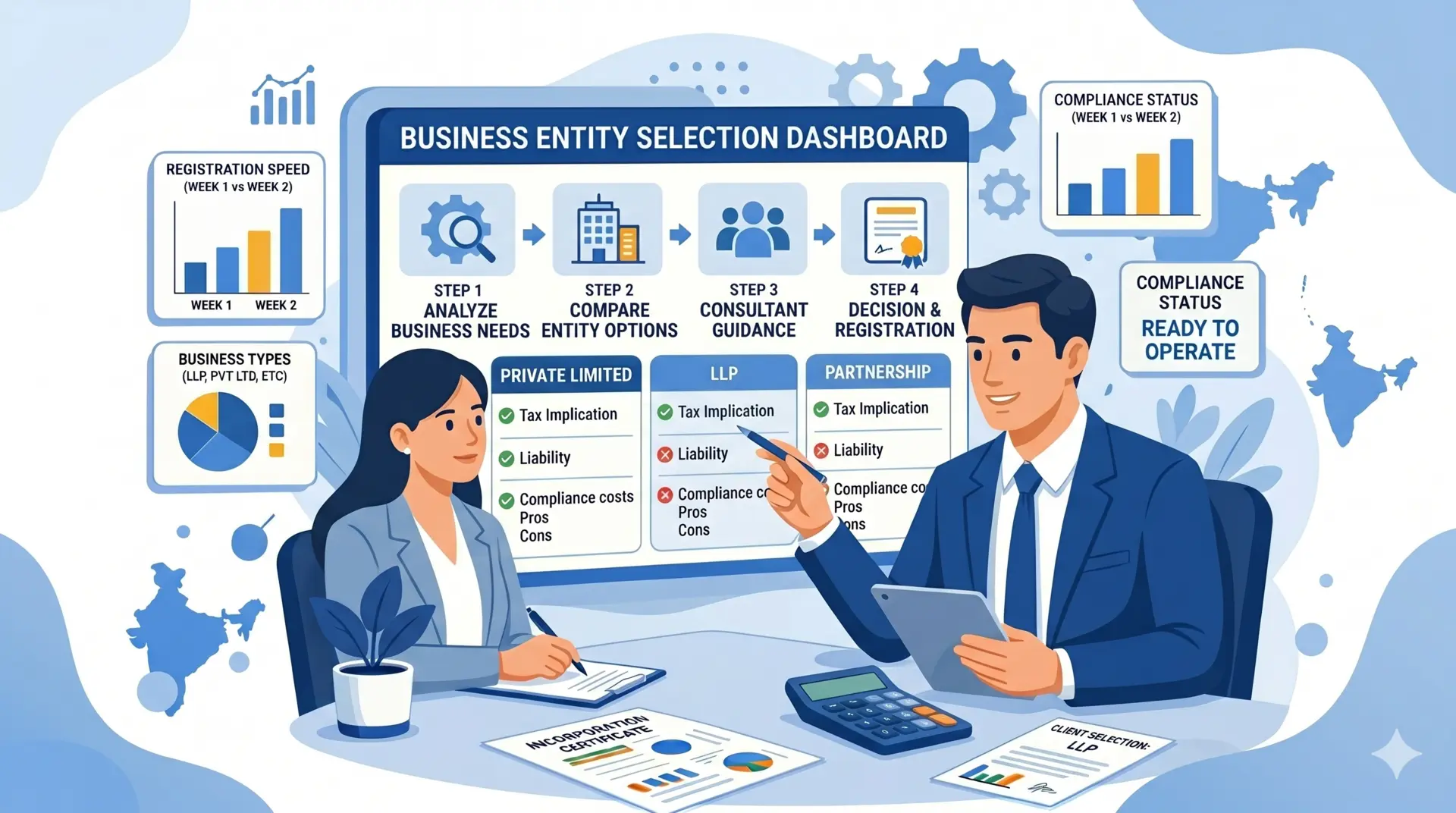
Choosing the right business structure is one of the most important decisions for entrepreneurs and startups. Different types of business registration in India offer unique advantages related to taxation, liability, compliance, and scalability. Selecting the correct structure helps businesses operate efficiently while ensuring legal and financial protection.
Private Limited Company Registration
A Private Limited Company is one of the most popular business structures for startups and growing businesses in India. It offers limited liability protection, separate legal identity, and better opportunities for funding and investment. This structure is ideal for businesses planning long-term growth and scalability.
Limited Liability Partnership (LLP) Registration
An LLP registration combines the flexibility of a partnership with the benefits of limited liability. It is suitable for professionals, agencies, and service-based businesses looking for lower compliance requirements and operational flexibility.
Sole Proprietorship Registration
A sole proprietorship is the simplest form of business registration in India, best suited for small businesses, freelancers, and local traders. It involves minimal compliance and is easy to start and manage.
One Person Company (OPC) Registration
An OPC registration allows a single entrepreneur to enjoy the benefits of a company structure with limited liability protection. It is an ideal option for solo founders who want a separate legal entity for their business.
Partnership Firm Registration
A partnership firm is formed when two or more individuals jointly operate a business and share profits and responsibilities. It is commonly chosen for family businesses and small enterprises due to its simple formation process.
Startup Registration in India
Startups can also register under the Startup India initiative to avail tax benefits, government recognition, funding support, and easier compliance. Startup registration is highly beneficial for innovative and scalable business ideas.
The ideal business structure depends on factors such as business size, ownership, investment plans, taxation, and future expansion goals. Choosing the right registration type at the beginning helps avoid legal and operational complications later.
Benefits of
Business Registration
in india
Registering a business is more than just a legal formality — it creates a strong foundation for growth, credibility, and long-term success. Proper business registration in India helps entrepreneurs operate legally while gaining financial, operational, and branding advantages in a competitive market.
Legal Recognition and Business Credibility
A registered business gains official legal recognition, helping build trust among customers, investors, vendors, and financial institutions. It also improves your professional image in the market.
Limited Liability Protection
Business structures such as Private Limited Companies and LLPs provide limited liability protection, safeguarding the personal assets of owners from business debts and legal risks.
Easy Access to Funding and Investment
Registered businesses can easily apply for business loans, attract investors, and raise funding from banks, venture capital firms, and government schemes.
Smooth GST and Tax Compliance
Business registration simplifies compliance with GST, income tax, and other legal requirements, helping avoid penalties and operational issues in the future.
Ability to Open Current Bank Accounts
A registered business can open a dedicated business bank account, making financial management more professional and organized.
Better Growth and Expansion Opportunities
Registered businesses can scale operations more efficiently, expand into new markets, hire employees, and work with larger clients and corporations.
Choosing the right business structure and completing registration at an early stage helps businesses avoid legal complications while creating a scalable and growth-oriented foundation.
Steps for Business Registration in India:
Business Registration Process in India
The business registration process in India is designed to help entrepreneurs legally establish and operate their businesses under government regulations. Whether you are starting a startup, private limited company, LLP, or small business, understanding the registration process ensures smoother compliance and faster approvals.
01.
Step
Choose the Right Business Structure
The first step is selecting the most suitable business structure based on your goals, ownership, taxation, and scalability requirements. Common options include:
- Private Limited Company
- LLP (Limited Liability Partnership)
- Sole Proprietorship
- OPC (One Person Company)
- Partnership Firm
02.
Step
Apply for Digital Signature Certificate (DSC)
A Digital Signature Certificate (DSC) is required for online company registration filings in India. Directors and partners must obtain DSC to digitally sign government forms and documents securely.
03.
Step
Obtain Director Identification Number (DIN)
For company and LLP registration, directors must apply for a Director Identification Number (DIN) issued by the Ministry of Corporate Affairs (MCA).
DIN is mandatory for individuals becoming company directors.
04.
Step
Reserve Business Name
The next step is applying for business name approval through the MCA portal. The selected name must be unique, legally acceptable, and aligned with your business activities.
A properly chosen business name strengthens branding and legal identity.
05.
Step
Prepare and Submit Registration Documents
Applicants must submit required documents such as:
- PAN card and Aadhaar card
- Address proof
- Passport-size photographs
- Registered office proof
- Business incorporation documents
06.
Step
File Incorporation Application
After document preparation, the incorporation application is filed online with the MCA or relevant authorities based on the business type.
Government verification is conducted during this stage.
07.
Step
Receive Certificate of Incorporation
Once approved, the business receives the Certificate of Incorporation, officially recognizing the company as a legal business entity in India.
08.
Step
Apply for GST and Other Registrations
Depending on the business type and turnover, additional registrations such as GST registration, PAN, TAN, and professional tax may also be required.
The business registration process in India is now largely online, making it faster and more convenient for startups and entrepreneurs. However, proper documentation and compliance are critical for successful approval.
Documents Required for
Business Registration in india
Submitting the correct documents required for business registration in India is one of the most important steps in the company registration process. Proper documentation helps verify the identity, address, ownership, and legal status of the business, ensuring smooth approval from government authorities.
Whether you are applying for Private Limited Company registration, LLP registration, OPC registration, or sole proprietorship registration, keeping all mandatory documents ready helps avoid delays, rejection, and compliance issues.
Essential Documents Business Registration in India
For example, the required documents vary depending on the type of business entity:
Proprietorship Firm
- PAN card of proprietor
- Aadhaar card
- Passport-size photograph
- Business address proof
- Bank account details
- GST registration (if applicable)
Partnership Firm
- PAN card of all partners
- Aadhaar card of partners
- Partnership deed
- Address proof of partners
- Registered office proof
- Passport-size photographs
LLP (Limited Liability Partnership)
- PAN card of designated partners
- Aadhaar card/passport/voter ID
- Passport-size photographs
- Registered office address proof
- Digital Signature Certificate (DSC)
- Director Identification Number (DIN)
- LLP agreement
Private Limited Company
- PAN card of directors
- Aadhaar card/passport/driving license
- Passport-size photographs
- Registered office proof
- DSC and DIN of directors
- MOA (Memorandum of Association)
- AOA (Articles of Association)
Public Limited Company
• Certificate of incorporation
• MOA & AOA
• PAN card of company
• PAN & Aadhaar of directors
• Board resolution for authorized signatory
• Business address proof for GST registration
• Bank account proof
• Digital Signature Certificate (DSC) for companies
Trust / Society / NGO
- PAN card of founders/trustees
- Aadhaar card and address proof
- Trust deed / Memorandum of Society
- Registered office proof
- Passport-size photographs
- NOC from property owner
- List of governing members
Choosing the correct business structure and preparing the required documents in advance helps reduce delays and ensures smoother business registration approval in India.
Before submitting documents, ensure that names, addresses, and identification details are consistent across all records to avoid rejection or resubmission requests during the registration process.
Common Document Issues to Avoid
Make sure all documents are clear, valid, and match your business details. Mismatched PAN, incorrect address proof, or blurred uploads are common reasons for Business registration rejection in India.
|
Document Type
|
Mandatory?
|
|---|---|
Who Should
Register a Business in india
Business registration is important for individuals and organizations planning to operate legally, build credibility, and scale professionally. Whether you are starting a small business, launching a startup, or offering professional services, completing business registration in India helps ensure compliance and long-term growth.
Business Registration in India
The following categories of businesses are required to register under MCA in India:
Startups and Entrepreneurs
Startups looking to raise funding, build a brand, and scale operations should register their business to gain legal recognition and investor confidence.
Freelancers and Consultants
Freelancers, agencies, and consultants providing professional services can benefit from business registration through better credibility, smoother GST compliance, and organized financial management.
E-commerce and Online Sellers
Businesses selling products or services through online platforms like Amazon, Flipkart, or Shopify should register to operate legally and manage GST compliance effectively.
Small and Medium Businesses (SMEs)
Local businesses, traders, and growing enterprises should register to access loans, open business bank accounts, and expand operations professionally.
Partnership and Family Businesses
Businesses operated jointly by partners or family members should complete partnership or LLP registration to define ownership roles and protect business interests legally.
NGOs, Trusts, and Societies
Organizations involved in charitable, educational, or social activities should register as trusts, societies, or NGOs to obtain legal recognition and government benefits.
Voluntary Registration
Many businesses start informally, but registering early helps avoid legal complications, improves trust, and creates a strong foundation for future growth and compliance.
If you plan to scale your business, hire employees, raise investment, or work with large clients, completing business registration at an early stage is highly recommended.
Why Choose Taxced for
Business Registration in India?
At Taxced, we simplify the entire business registration process in India with expert guidance, fast processing, and complete compliance support. Whether you are starting a startup, private limited company, LLP, or small business, our team helps you register your business smoothly and legally without unnecessary delays.
Expert-Led Registration Support
Our experienced professionals guide you through every stage of company registration, compliance, and documentation with accuracy and transparency.
Fast and Hassle-Free Process
We streamline the registration process to ensure quicker approvals and minimal paperwork for entrepreneurs and startups.
Complete Compliance Assistance
From business registration to GST registration and ongoing tax compliance, Taxced provides end-to-end support for businesses across India.
Affordable and Transparent Pricing
We offer cost-effective business registration services with clear pricing and no hidden charges.
Ready to Register
Your Business
Ready to register your business in India? Get expert assistance for company registration, GST compliance, and legal documentation with a fast and hassle-free process. Start your business journey confidently with Taxced’s professional registration support.
Business registration FAQs
(common question Answered)
Find answers to common questions about Business registration in India.
What is business registration in India?
Business registration in India is the legal process of establishing a business entity such as a Private Limited Company, LLP, sole proprietorship, or partnership firm under government regulations.
Which business structure is best for startups in India?
A Private Limited Company is considered one of the best business structures for startups due to limited liability protection, separate legal identity, and easier funding opportunities.
How long does business registration take in India?
The business registration process in India usually takes around 5–10 working days, depending on the type of entity, document verification, and government approvals.
What documents are required for company registration in India?
Common documents required for company registration include PAN card, Aadhaar card, address proof, passport-size photographs, registered office proof, and business incorporation documents.
Is GST registration required after business registration?
GST registration may be required depending on your business turnover, type of services, and business activities. Certain businesses must register under GST regardless of turnover.
Can a single person register a company in India?
Yes, a single individual can legally register a business through a One Person Company (OPC) or sole proprietorship structure.
What is the cost of business registration in India?
The cost of business registration depends on the business structure. Proprietorships generally cost less, while LLPs and Private Limited Companies involve higher registration and compliance costs.
Why is business registration important for startups and small businesses?
Business registration provides legal recognition, improves credibility, enables access to funding, simplifies tax compliance, and creates a strong foundation for long-term business growth in India.